
The Napoleonic period and the Risorgimento
Pages dedicated to the history of our city:
III. Mestre after Napoleon, the Austrian Empire, and the Kingdom of Italy (1797 - 1866)
The fall of the Venetian Republic
After the political upheavals of the French Revolution , Europe became a battlefield between Revolutionary France and the alliance of most of the European monarchies of the Ancien Régime .
In 1796, the First French Republic planned a major pincer offensive against the enemy coalition forces: a main attack would strike the states of the Holy Roman Empire (which would fall in 1806) from the west, while a harassing expedition would strike the Austrians and their allies from the south, through Northern Italy.
The territories of mainland Venice, which until then had remained neutral in the conflict, thus found themselves in the midst of the French army's advance towards Vienna, in what would be known as the Italian Campaign led by General Napoleon Bonaparte.
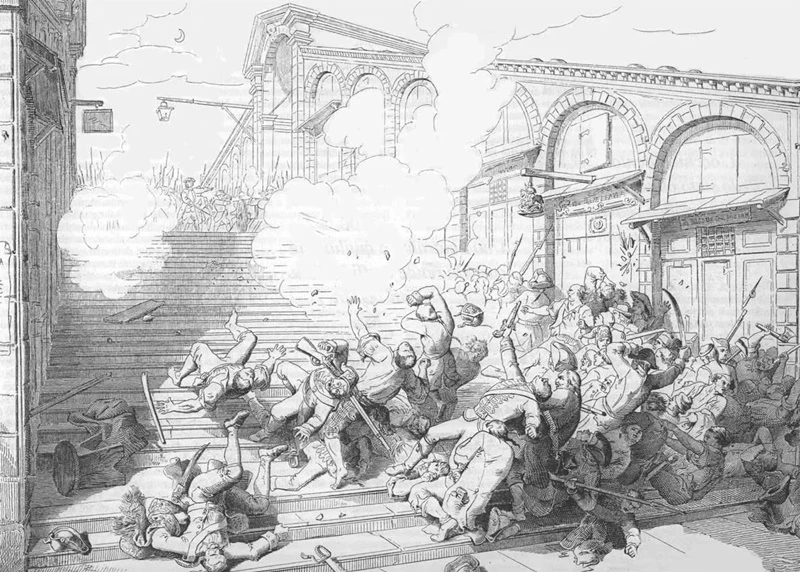
The final moments of the Most Serene Republic of Venice: French troops quell the last attempt of popular uprisings at the Rialto Bridge.
Neglect of defenses and underestimation of the danger led the Venetian government to offer mild resistance to the passage of foreign troops, allowing Napoleon's troops to advance unchecked into Venetian territories, which were gradually converted to the new French revolutionary ideas.
The situation in various cities degenerated into direct conflict, which had in fact been long-planned by France: on April 17, 1797, coinciding with the Veronese Easter uprisings against French occupation, Napoleon signed a preliminary peace treaty in Leoben with representatives of the Austrian Emperor Francis II. The secret clauses annexed to the treaty already stipulated the cession of Venice's mainland dominions to the Empire, in exchange for the latter's evacuation of the Netherlands.
Napoleon's armies advanced rapidly, and Venice now seemed to consider the mainland lost, as at the time of the League of Cambrai , but without resolving to definitively demobilize it to gather its forces.
The lack of resolution would prove the downfall of the Venetian Republic, and belated attempts at reconciliation would prove futile. By May 1st, Napoleon had already reached Marghera, at the gates of the lagoon, and declared definitive war on Venice, which would ultimately be forced to dissolve its government on May 12th, 1797, and surrender to the French Provisional Municipality .
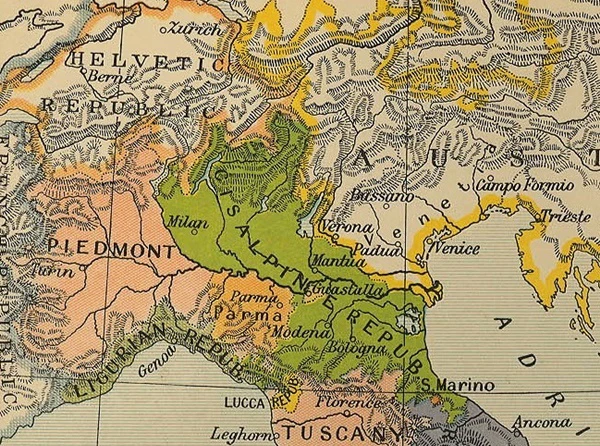
Northern Italy in 1799, after the Treaty of Campo Formio
Austrian domination
The hopes of the Italian Enlightenment thinkers, deluded that the arrival of Napoleon's troops would bring the ideals of freedom established beyond the Alps with the French Revolution to the Italian peninsula, were betrayed by Napoleon.
Indeed, with the Treaty of Campo Formio , signed on October 17, 1797, with the Holy Roman Empire, France renounced further conflict and divided Northern Italy with the Archduchy of Austria, which was assigned the territories of the Republic of Venice, which still formally existed under the government of the Provisional Municipality, as agreed in the secret clauses of Leoben.
In exchange, the Austrian Empire ceded other territories in continental Europe to France and recognized the Cisalpine Republic established by Napoleon in Italy.
The war between France and Austria, however, did not end, and following the Treaty of Pressburg in 1805, Veneto and Friuli briefly became part of Napoleon's Kingdom of Italy .
In 1806, Mestre, following the French model, became a "Comune" within the Department of the Tagliamento (the current province of Treviso) and was given a council of 40 members and a Podestà appointed by the central government. In 1808 it passed to the Department of the Adriatic (the current province of Venice) and in 1810 it absorbed the municipalities of Carpenedo , Trevignan , and Favero .
Following the fall of Napoleon, the Congress of Vienna of 1814, as part of the Restoration of the powers of absolute sovereigns in Europe, did not restore independence to the territories of the Republic of Venice, which were instead united with those of the Duchy of Milan in the newly established Kingdom of Lombardy-Venetia . The latter, subject to the Austrian Empire, roughly encompassed the territories of today's Veneto, Lombardy, and Friuli and would last until annexation by the Kingdom of Italy in 1866.
During this period of Austrian rule, important infrastructure projects were built, such as Forte Marghera , begun in 1805 and completed in 1842, and the great bridge over the Venetian lagoon connecting Mestre and Venice, inaugurated on January 11, 1846, as part of the Ferdinandea Milan-Venice Railway. This was joined in the 20th century by the road bridge known as Ponte Littorio , inaugurated on April 25, 1933.
The strategic link of the Canal Salso , for four centuries the umbilical cord between Venice, Mestre, and the mainland, now lost its importance, with significant economic benefits for the city.
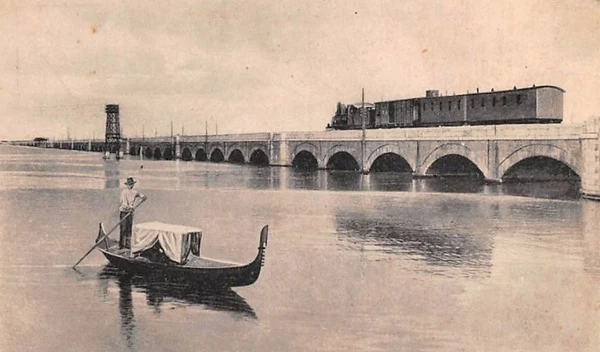
Railway bridge over the lagoon in a historical image
The Mestre sortie of 27 October 1848
After thirty-four years of Austrian rule, the opportunity to demonstrate their discontent was now awaited. The spark against all the Restoration governments was ignited on January 12, 1848, in Palermo, and quickly spread to Naples, Paris, Vienna, Milan, and then Venice, where on March 22, Daniele Manin , leader of the insurgents, expelled the Austrians and proclaimed the Republic.
In Mestre, many patriots, notably the pharmacist Luigi Reali , easily disarmed the few soldiers on guard in the city, most of whom came from the Veneto region and therefore quickly sympathized with the insurgents.
Having established a Civic Guard, they marched against Fort Marghera , which they managed to capture thanks to a passage indicated to them by smugglers and the element of surprise.
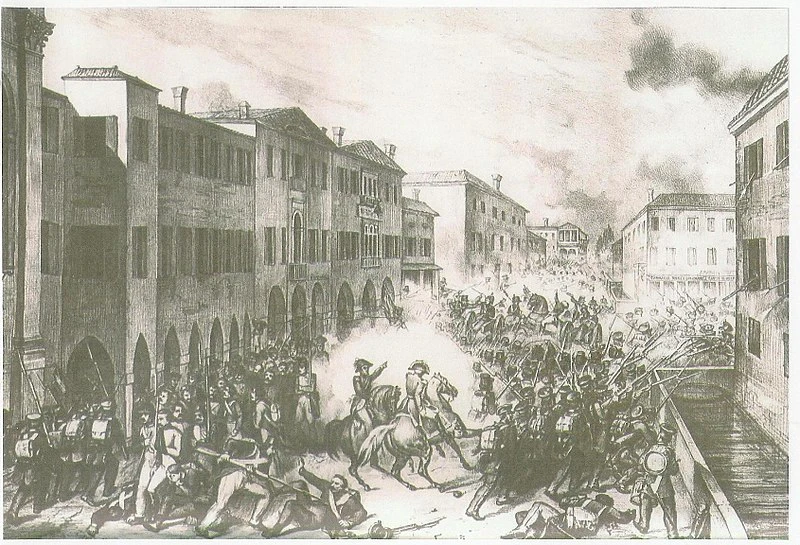
Mestre sortie of 27 October 1848, fighting on Via delle Muneghe (now Via Alessandro Poerio) and on the Ponte della Campana
Many volunteers joined the action from all over Italy, arriving in many localities of Lombardy-Venetia, while the Austrian contingents had barricaded themselves, especially in the Quadrilatero . Mestre became a crossroads for these young men, among whom were many idealists, but also some adventurers ready to take advantage of the situation. A Neapolitan division, led by General Guglielmo Pepe, particularly stood out, joined by the most courageous of the volunteers. Their names are remembered today in the toponymy of Mestre: Guglielmo Pepe , Alessandro Poerio , Cesare Rossarol , Antonio Olivi , Enrico Cosenz , and Girolamo Ulloa . Having defeated the Piedmontese troops and aimed at reconquering the entire Lombardy-Venetia, on June 18, 1848, the Austrian troops re-entered Mestre, reoccupying it and using it as a bridgehead for the siege of Venice.
The bold but short-lived Mestre Sortie of October 27, launched from Forte Marghera, liberated Mestre again for a few hours: however, it was largely a dramatic operation, not destined to last over time given the disproportion between Venetian and Austrian forces.
In memory of the events of 1848, on April 4, 1886, a commemorative column for those fallen in the resistance of 1848-1849 was inaugurated in Piazza Barche, now Piazza XXVII Ottobre , while on November 13, 1898, the city was awarded the Gold Medal for Military Valor. A plaque on the Bell Bridge also commemorated the heroism, brought from distant lands, of the two Polish sergeants, Costantino Mischevitz and Isidoro Dembowski , who died on the Bell Bridge.
On 26 May 1849 the Fort was reconquered by the Austrians and, following the latter's capitulation, Venice itself surrendered on 22 August.
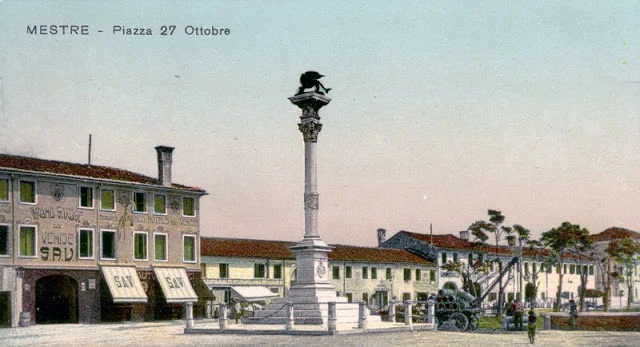
October 27th square in a period postcard with the commemorative column of the Mestre Sortie "Among the ruins of her country, Venice — alone in arms — for the freedom of Italy — with elite troops — of volunteers — challenging — a powerful enemy host — takes the field — fights, triumphs — October 27th — MDCCCXLVIII"
Annexation to the Kingdom of Italy
n 1866, Mestre witnessed the entry of Italian troops into Forte Marghera, having arrived in the city on July 15th following the outcome of the Third War of Independence , which saw the Austrian Empire cede the Veneto to France, which in turn ceded it to the Kingdom of Italy led by the House of Savoy .
The city was then officially annexed to the Kingdom of Italy , along with the rest of the Veneto, following the Veneto Plebiscite of 1866, with universal male suffrage held on October 21st and 22nd. On March 6th, 1867, Giuseppe Garibaldi himself arrived in Mestre , visiting the recently annexed Veneto. The General addressed the citizens from the famous balcony of Palazzo Da Re, an event later commemorated with a plaque.
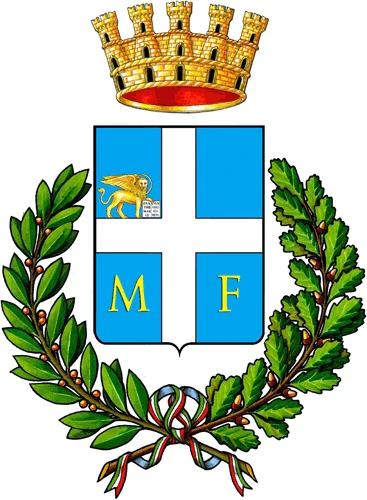
Current coat of arms of the city of Mestre
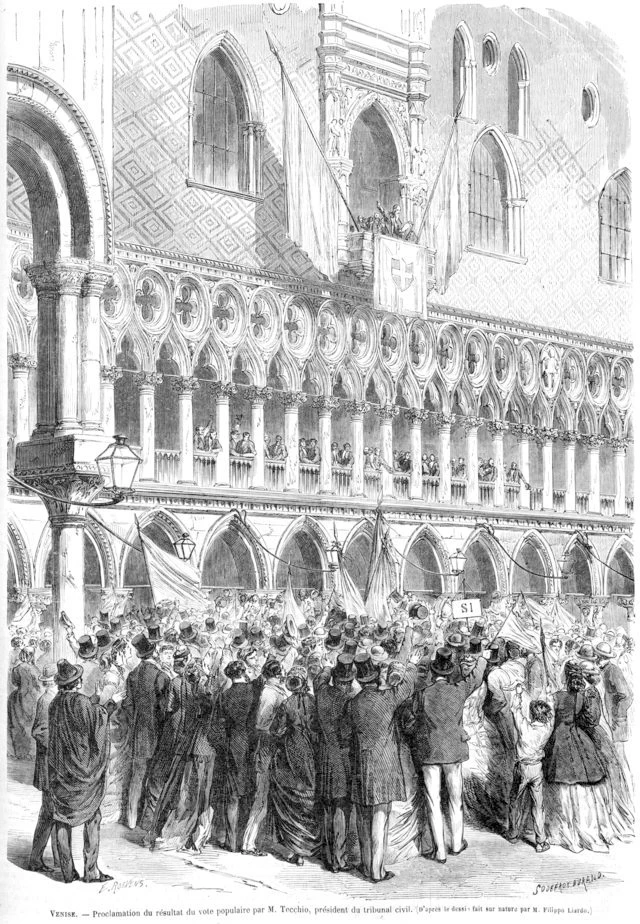
Proclamation of the results of the plebiscite of 1866
The municipality of Mestre presents itself with a banner resulting from successive modifications: on May 26, 1923, Mestre was officially granted the title of "city" by King Vittorio Emanuele III, and the medieval coat of arms, modified during the Venetian era, was confirmed as the city's coat of arms. The coat of arms consists of quarters on a blue background with a silver cross featuring the lion of St. Mark and the letters m and f ( Mestre fidelis ) in gold in the first, third, and fourth quarters, respectively, surmounted by a five-towered Guelph crown. In 1898, Mestre was awarded the gold medal by Umberto I, which was added to the banner, for the events of 1848. In 1876, the old Belfredo Tower, one of the last vestiges of the ancient castle, was demolished by its private owners. Traces of the tower's plan remain in the paving of the street of the same name, adjacent to the "Giardini delle Mura" where the remains (as well as a long section of wall) of one of the castle's smaller towers are visible.
With the spread of new technologies of the industrial revolution, Mestre began to take on the size and structure of a city, equipping itself with factories, theatres, a market, trams, public lighting and an aqueduct.
Read the other chapters
I. From the first evidence of the birth of Mestre to the medieval period (up to 1337)
II. Mestre territory of the Republic of Venice (1337 - 1797)
III. Mestre after Napoleon, the Austrian Empire and the Kingdom of Italy (1797 - 1866)
IV. Mestre during the twentieth century and the modern era (1866 - today)
These texts are intended for the widest possible audience and are intended as a general introduction to the city's history.
Despite our efforts, we cannot presume to have made no mistakes: we are open to corrections and observations, which you can send us via our contact form.