
From the Industrial Revolution to the new millennium
Pages dedicated to the history of our city:
IV. Mestre during the twentieth century and the modern era (1866 - today)
A growing city
In the second half of the 19th century, having become part of the Kingdom of Italy (1866), Mestre began to take on the dimensions and structure of a true city.
In addition to the railway station, built under the Austrian Empire in 1859, during this period Mestre acquired other important public infrastructures: the public electric lighting network (1899), the horse-drawn tram network (1891) and then the electric tram network (the first in the Veneto, in operation from 16 October 1905 and later replaced by trolleybus lines) and the municipal aqueduct (inaugurated on 27 October 1912).
Concurrent with the inauguration of the aqueduct, the Galleria Vittorio Emanuele opened (one of the first in Italy, second only to the Galleria in Milan). It combines, in steel and glass, in true Parisian style, the two buildings built by the Toniolo family next to the eponymous theater, which was under construction at the time. The theater, in turn, opened its doors a few months later, on August 30, 1913, complementing the cultural offerings of the Cinema Excelsior, built in 1911 thanks to Vittorio Furlan, a pioneer of film distribution and exhibition.
During this period, many important manufacturing companies were also established, creating related industries and wealth, such as the Da Re furnace , the Carbonifera Industriale Italiana plant (today the complex has been renovated and used for residential and office purposes, retaining its name), the Matter lubricants company, and the Taboga sweets factory.
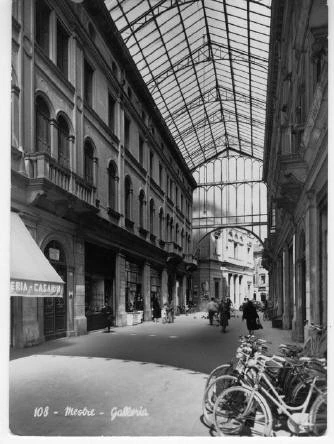
Galleria Vittorio Emanuele (now Galleria Matteotti) in a vintage postcard
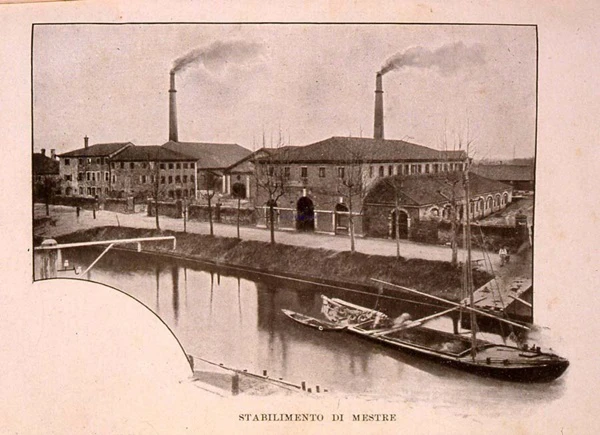
All these new businesses represented the birth of an economy detached from its simple geographic role of trade with the lagoon, a role that was nevertheless preserved by their location along the Canal Salso.
The transformation of what had been a small commercial village was now clear, and on May 26, 1923, Mestre was also officially awarded the title of "city" by King Vittorio Emanuele III.
Fornace Da Re, built in 1852, comprises a brick kiln and a lime kiln, a sawmill, a stone shaping plant, warehouses for cereals and wood and even houses for the workers, an example of the particular manufacturing production method in the phase preceding industrial take-off.
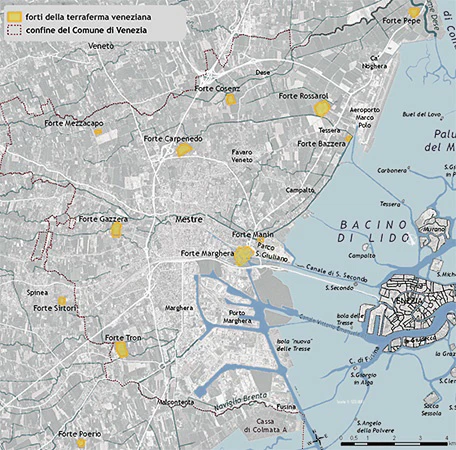
The forts of the Mestre Entrenched Camp on a current map
The World Wars and the Entrenched Camp
In 1883, work began on the construction of the new entrenched camp of Mestre : Forte Carpenedo , to the north, on the road to Treviso, completed in 1887; Forte Gazzera , to the northwest, on the road to Castelfranco, completed in 1886; and Forte Tron , to the southwest, on the road to Padua, completed in 1887. The three fortresses were built in a polygonal shape, identical to each other, and placed at a distance of 3,500-4,500 m from Forte Marghera , which constituted the second line.
At the beginning of the 20th century, the growing tensions that would later erupt into the Great War led to a review of the defensive system of Mestre, considered strategic. A further, more external ring of fortifications was then created, consisting of seven new fortresses, which exploited the natural defense provided by the Dese River to the north (Fort Bazzera, Fort Rossarol, Fort Pepe, Fort Cosenz, Fort Mezzacapo, Fort Sirtori, and Fort Poerio), thus creating one of the most powerful defensive systems in Europe.
In 1915, with the outbreak of the First World War , Mestre's defensive system was complete and fully operational. However, the unexpected developments of the conflict, which had transformed into trench warfare, and the vulnerability of the border fortifications, pushed the Italian High Command to order, in September of that same year, the dismantling of the Mestre field's protective batteries, which were sent to reinforce the front.
During the conflict, Mestre nevertheless played an important role in the exchange and distribution of troops, armaments, and supplies thanks to the presence of the railway station, which intersected the lines leading to the front (lines to Udine, Trieste, and Trento) and which came from the Bologna and Milan routes.
With the defeat at Caporetto, a new front line was proposed in Mestre, anchored by the fortified structure of the Entrenched Field. Fortunately, the halt on the Piave River averted this dramatic scenario, and Mestre became the immediate logistical rear of the front: schools, villas, and private homes were requisitioned and used as field hospitals, barracks, and sorting centers.
Since the Second World War, the forts had lost their military function, being progressively transformed into barracks, gunpowder magazines, and warehouses, until their final abandonment in the 1980s. They are now used for historical and cultural purposes, and also possess great naturalistic value, housing an environment that remained virtually untouched for over a century.
During the Second World War, Mestre suffered several aerial bombardments; The worst occurred on March 28, 1944, which razed more than a thousand homes, resulting in 164 deaths and 270 injuries, as well as displaced many who were forced to abandon their homes and seek shelter in the surrounding countryside. After the signing of the armistice, Mestre was the scene of clashes between resistance forces and Nazi-Fascist forces, who immediately attempted to occupy it, partly because of its role as an important railway hub.
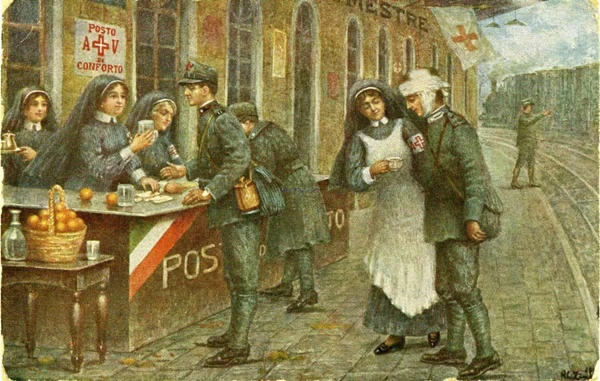
Propaganda postcard of the soldiers' refreshment stand at the Mestre railway station
Annexation to "Greater Venice"
In 1926, Mestre, along with the municipalities of Chirignago , Favaro Veneto , and Zelarino , was annexed by ministerial decree to the Municipality of Venice , in order to guarantee ample scope for port, industrial, and residential expansion to the lagoon city, which, due to its urban layout, lacked suitable space.
Thus was born the so-called Greater Venice , conceived as a new city built around a true tripartite plan for the territory: Venice and the Venice Lido for culture and tourism, the newly built Marghera for the port and industry, and Mestre for residential use.
In the Bottenighi area, later named Marghera in honor of the events of 1848, after an initial expropriation of land from the municipality of Mestre in 1917, work began in 1922 on one of the largest industrial zones in Europe, initially specializing primarily in the iron and steel, metallurgical, chemical, petroleum, energy, shipbuilding, and later also food sectors. At the end of World War II, the industrial area expanded southward with the so-called "Second Zone," primarily devoted to petrochemicals and aluminum processing. At 1,010 hectares, it doubled the size of the original settlement.
These years saw considerable population growth in the Mestre area, but this was offset by a decline in the city's social and cultural role.
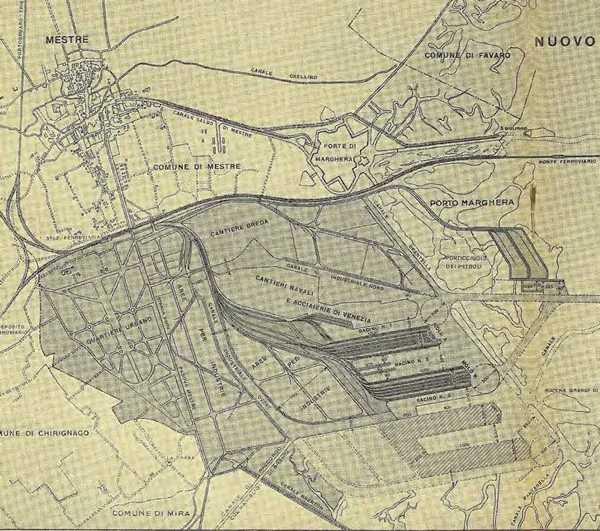
Project for the new Port of Venice at Bottenighi, built in 1922
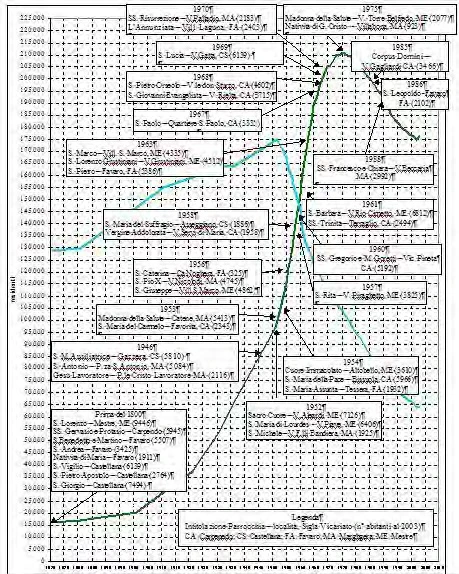
Demographic trend of Mestre (in black) and Venice (in blue) (with an indication of the years of establishment of the new parishes on the mainland)
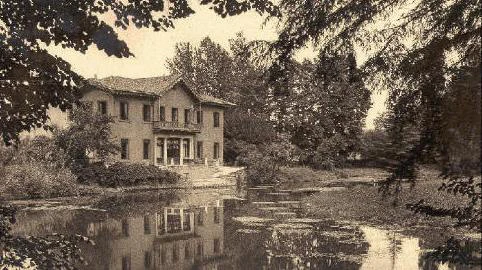
Ponci Park, razed to the ground along with the villa of the same name in one night, is a symbol of the 20th-century "sack of Mestre."
Uncontrolled growth and property speculation
The new industrial hub attracted workers and laborers from Venice, from the poor and rural Veneto, and then from the most deprived areas of the country. They soon overwhelmed the housing available in the Garden City of Marghera, built in the 1920s according to the most advanced English-style urban planning criteria. This strong immigration therefore necessarily found its outlet in the center of Mestre, which from 20,000 inhabitants at the beginning of the century reached a peak of 210,000 in 1975, after the disastrous effects of the 1966 flood compounded the housing and labor policies unfavorable to lagoon residents.
Mestre thus experienced rapid and often poorly-quality growth, which created vast and crowded residential neighborhoods for workers, employees, and those who could not live in nearby Venice for reasons of hygiene and overcrowding. Thus, for example, in the 1950s, in a single night, a team of Friulian lumberjacks destroyed a centuries-old park in the heart of the city, Parco Ponci , to make way for condominiums, shops, offices, and homes.
Without an adequate regulatory framework, speculative activity grew: the urban layout was overturned, with radical changes to entire areas of the city and the demolition of monuments and historic sites. Among the most impactful interventions were the filling in, narrowing, or diverting of many of Mestre's canals; the culverting of the Marzenego ; the construction of the Cel-Ana building adjacent to the Torre , Mestre's first symbol; and the filling in of the Canal Salso from Piazza XXVII Ottobre (the historic Piazza Barche ).
The chemical industry crisis of the late 1980s and early 1990s, along with the general downsizing of major cities in northern Italy, curbed the growth of residents in Mestre and the surrounding suburbs. Nonetheless, the over 180,000 mainland residents still make up over 66% of the population of the municipality of Venice (almost 90,000 in the Mestre-Carpenedo municipality).
Contemporary Mestre: urban redevelopment
Today's Mestre is a constantly evolving contemporary city, the geographic and functional center of the Metropolitan City, with an increasingly important role in the economic, social, and cultural dynamics of one of the country's most important urban areas.
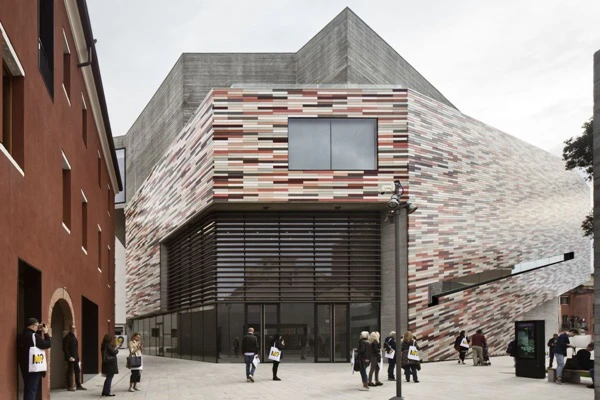
View of the 20th Century Museum - M9, an international urban regeneration project
The first significant project was the pedestrianization of areas of the historic center, first and foremost Piazza Ferretto (in 1984). Redevelopment projects followed in many historic areas of Mestre, the most notable of which also took place in the square. Other projects were carried out inside the Civic Tower, on Via Palazzo, Via Caneve, Via Manin, Via Poerio, and so on.
Recent years have seen the construction of the tramway, the opening of the Mestre forest to the public, the creation of new shopping areas, and the new Angelo hospital. Other examples of redevelopment include the reconstruction of the Centro Candiani conference center, the restoration of the Toniolo Theater, the creation of new executive quarters in the southern part, and the reclamation of the area surrounding the new San Giuliano park.
A diverse city, a bustling hub of people, goods, and businesses, and a major rail, highway, and airport hub, Mestre is now carving out a prominent role for itself in the cultural and tourism sectors as well.
Read the other chapters
I. From the first evidence of the birth of Mestre to the medieval period (up to 1337)
II. Mestre territory of the Republic of Venice (1337 - 1797)
III. Mestre after Napoleon, the Austrian Empire and the Kingdom of Italy (1797 - 1866)
IV. Mestre during the twentieth century and the modern era (1866 - today)
These texts are intended for the widest possible audience and are intended as a general introduction to the city's history.
Despite our efforts, we cannot presume to have made no mistakes: we are open to corrections and observations, which you can send us via our contact form.