
Historical insights
Regattas and Regatta Participants in Mestre
edited by: Giorgio & Maurizio Crovato
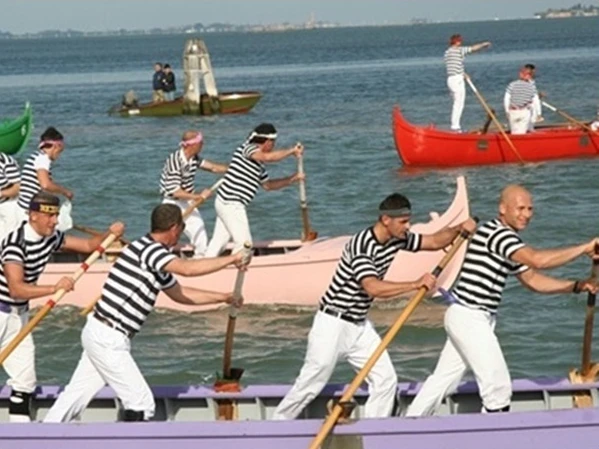
The Mestre regatta
The Mestre Regatta is currently organized, as part of the municipal regattas, by the City of Venice, in May, the first event in the lagoon rowing calendar. The current course begins in the Marani Canal (near the Murano Lighthouse), the Nave Canal, the San Secondo Canal, the Giro del Paletto, the Seno de la Sepa, and then back to finish at Punta San Giuliano. The event includes two races: the first, for women, in four-oared gondolas, and the second, for men, in six-oared caorline. The Salso Canal, a true historic venue for the competition, is missing. We believe it is useful to retrace the history of the Mestre Regatta, starting from its origins and extending to the 1920s and 1930s. Since the Second World War, the Mestre Regatta has been included in the municipal calendar.
Water, boats and leisure: The origin of regattas
The standing rowing regatta, or Venetian rowing, is an essential element of the celebrations of a community that lives around the waters of the lagoon and the numerous surrounding rivers and canals. In the same spaces where rowing is used to communicate, to trade, and to work, it is common for water to be used during celebrations as well. This has been the case for centuries in Venice, Murano, Burano, Torcello, Lido, and Pellestrina, in Mestre, Marghera, Fusina, Campalto, Tre Porti, and other towns on the mainland lagoon.
The regatta is linked to the particular rowing style, suited to navigating calm waters, looking ahead to control the course, and is constantly evoked in documents and iconography of local history. The unique nature of the rowing race, however, has led a considerable number of historians throughout the ages to classify the regatta exclusively under the heading of "celebrations," without a specific and independent definition, and sometimes to include it under the heading of "parade."
The celebration of the sporting act is not explicitly emphasized, but it is only mentioned secondarily, perhaps in keeping with historical contingency, giving space to the sensational and original events pompously organized throughout the Middle Ages and the Modern Era by the Most Serene Republic of Venice.
It is so natural that rowing is the foundation of daily and festive activities that it is often never considered as such, and especially not as a sporting event. The regatta is a competition: originally, the pioneers adapted to the competition with boats and rudimentary means of transport. It was the youngest who competed against their peers. The organization was spontaneous, left to the initiative and leisure of individuals and family groups. Even the means of transport reflected the characteristics of primitive populations: tree trunks became means of transportation, sticks were perfected into rudimentary oars. The meeting of the river and the lagoon was the ideal place for the first contests. Another element has perhaps been overlooked by scholars: regattas involved both men and women. This is a singular fact, not only for European culture, with women as "protagonists" of a "sporting" event, even though the concept of sport originated in contemporary times. Since the Middle Ages, champions, both male and female, have been celebrated—as we would say today—"with equal opportunities," including in the personal glorification of the myth, with the custom of portraits and evocative poems, at the time reserved only for the ruling class of nobles and crowned heads.
An identity event for the community living around the lagoon
To our contemporary eyes, it's rather surprising to learn how a humble and simple "common thread"—the regatta—ties our historical roots together, highlighting some of the prejudices and inventions of tradition, brought about by modernity, when the use of automobiles perhaps caused a rift in the habits of those who live on the mainland and those who live in the lagoon. The history of regattas teaches us that competition has been present for centuries in every location with contact with the lagoon water, where young men and women, following their natural vocation for competition and fun, challenge each other with the most common means of transport available: the boat.
Little changes during the Serenissima, although the regattas, particularly those held on the Grand Canal, often take on a more of a show-within-a-show function, benefiting foreign guests and never excluding popular participation. In his description of Mestre, Carlo Goldoni praises its qualities and compares it to the Palace of Versailles, having Pantalone say in The Brilliant Maid, an opera from 1754: “ …And now Mestre has become a miniature Versailles. It flows from the Marghera Canal, it extends across the entire town, and then the Terraggio runs all the way to Treviso. You will struggle to find anywhere in Italy, or outside of Italy, a resort as long, as unique, as populous as this one. There are casinos that look like galleries, there are palaces fit for cities, for sovereigns. Stupendous conventions are held, magnificent balls are held. Every moment you see the post, carriages, horses, lackeys rushing by: ebb and flow at all hours. I will retreat to the land, far from the noise, because I enjoy my freedom… ”.
The end of the Ancien Régime and the Napoleonic turmoil changed the tradition, which was partially revived during the city's Austrian administration. A radical change (and a revival of the regattas) occurred in 1866. This was a significant date for the Risorgimento and a significant date for regattas in the lagoon. From this moment on, the racecourses occupied, or rather reoccupied, other spaces, in addition to the more traditional St. Mark's Basin and the Grand Canal.
The resistance of the Mestre boatmen
From a waterfront city, Mestre underwent a transformation in the twentieth century, when it was incorporated into the municipality of Venice. It became a modern residential center, alongside the industries of Marghera, but it neglected, at least for a few years, its ancient traditions. The community of boatmen in Mestre was the most important in the lagoon. From the work of Luigi Brunello of the Mestre Historical Studies Center (THE SCHOOL OF SAN NICOLÒ DE' BARCAJUOLI DI MESTRE), it emerges that the Mestre boatmen were organized into a fraternity since the early sixteenth century: the School of San Nicolò is located next to the church of San Girolamo, which once overlooked the "Rio di San Girolamo", later filled in to meet the demands of modernity, which favored land routes over water. The boatmen of Mestre also relied on another school in Venice, headed by the church of San Felice, in the Cannaregio district, which together had no fewer than 500 members in 1847. The Mestre boatmen also had two stazi (small stations located on the fondamenta) in Venice: one on Fondamenta di San Giobbe, also in Cannaregio, and the other in the canal adjacent to Campo di San Stae, in the Santa Croce district. The construction of the railway bridge and the arrival of the first locomotive between Venice and Mestre in 1846 penalized the boatmen 's activity , which was important to the local economy (Mestre had approximately 8,000 inhabitants at the time).
The " Mariègola della Scuola di San Nicolò " (a manuscript book containing the guild's rules), now preserved at the British Library in London, states: " For every ferry departing from Mestre or Marghera for Venice, a contribution of one soldo was required, which was collected by appointed persons stationed where the Salso Canal emptied into the lagoon... ". The ferry departing from the mainland ensured the daily flow of goods and people to the lagoon center. For those coming from the south, the Fusina ferry operates. Perhaps less important but equally dynamic is the Campalto ferry, on the route to Murano and the Fondamente Nove in Venice. The Republic regulates all " external" ferry activity, just as it does with " internal ferries ." An interesting story is reported by the recently deceased historian Giorgio Zoccoletto in his book "MESTRE IN THE LATE SEVEN CENTURY: THE INNS OF S. MARCO AND S. TODARO," regarding the Mestre-Marghera ferry: "
Although a decree issued by the Senate on March 18, 1677, had settled the issue, the dispute remained open. On one side were the ferrymen of Mestre and Marghera, on the other the illegal operators of Campalto. The former were the only ones authorized to transport people and goods from the banks of the Salso Canal to the San Giobbe station. To perform their service, they had to obtain a license, or freedom, from the magistrate to the militia da mar and submit to the corporate rules dictated by the avogadori di comun . Freedom meant the right for the barcaro to occupy a place on the traghetto. Freedom, which evidently excluded the barcari of Campalto.
In the history of regattas held after Italian unification, the Mestre regatta is the third to be revived in chronological order after those on the Grand Canal in Venice and that of Murano. In contemporary historiography, much emphasis is given to the ferries and the boatmen of Mestre, and perhaps less consideration is given to the organization of the regattas between the Salso Canal and the lagoon. Their memory survives thanks to the newspapers and also thanks to publications by archival researchers such as Sergio Barizza, Luigi Brunello, and Giorgio Zoccoletto.
The Mestrini rowing champions
Reading the newspapers, and in particular "IL GAZZETTINO," the names of the most successful regatta participants emerge. The newspaper "IL TEMPO" of 1894 offers an account of the Mestre regatta, which notes that the regatta participants from Mestre and Marghera are among the champions who have won in other competitions held in the lagoon: for example, the Mestre residents Giuseppe Basana and the Dorigo brothers, Vincenzo Dogà (Silvestro), Chichisiola Antonio (Bagari), Danesin Giuseppe (Duca), Antonio Goattin, Luigi Vizionato (capo), Sante Gaggiato, Adolfo Franchin, Pietro Vizionato, Vincenzo Giacometto; from Marghera, the regatta participants Massimiliano Cellere and Giovanni Zanon are mentioned. In the twentieth century, a generation of Mestre boatmen belonging to the same Uccelli family emerged , better known by the nickname Campaltini, even though they were all born and raised "alle Barche," in the " palazzòn dei barcaroli" (boatmen's building ) on the banks of the Salso Canal. Leaving from Campalto, they carried milk to Venice in heavy caorline. Every day, even those with the Bora wind. Giovanni and Giuseppe, cousins, participated in the 1926 Regata Storica and narrowly missed making it to the flag. Giuseppe (Bepi Osei Campaltin) declared: “ There was a lot of jealousy among the Venetian gondoliers, and it was more difficult for us poor boatmen from Mestre to be admitted to the Grand Canal regatta. It was the last year of the Mestre municipality. I still remember Mayor Paolino Piovesana. I practically lived on the boat. I would get up early in the morning, with the two-oared caorlina, but sometimes I would also do it with one oar; I would set off from Campalto in any weather, and if I was lucky I would even sail for some stretches. The route was always the same: Venice, the Pietà orphanage, the Ospedale al Mare, San Servolo, San Clemente, Sacca Sessola, and back. I would carry milk, almost 300 kilos, to these Venetian institutions. The great thing was that we found the time (and energy) to also participate in the regattas .” The youngest members of the Uccelli family, Fulvio and Federico, won numerous regattas on the Salso Canal and competed in Murano, Burano, Pellestrina, Sant'Erasmo, Campalto, and the Grand Canal, alongside renowned champions such as Strigheta, Ciapate, Crea, Ciaci, and the Fongher brothers. Federico (Rico Osei Campaltin) recalled: “ The Mestre Regatta has been held along the Salso Canal for over a century. On the day of San Micel, the regatta was also organized along with the great festival. Where Piazza Leonardo Da Vinci is now, the jousts were held in the middle of the meadows. It was then called the railway workers' field. The Salso Canal, then full of boats, reached right up to Corso del Popolo. I remember a certain Pippo Campossa who, with the help of the entire community, organized the great festival. We all started competing in regattas precisely on the occasion of that celebration .”
Beginning in the 1920s, company and youth regattas consolidated a significant growth thanks to the work of the OND (Opera Nazionale Dopolavoro). In Mestre, in 1929, on the Salso Canal, " Mr. Salvan, owner of the renowned Geremia restaurant, offered a delicious lunch to the first two competitors. The access to the boats was closed, and entry cost 1 lire. Water games included: cuccagna, triangle, and caccia del masaro, the wild duck ." By now, almost all regattas were organized by the OND, with the exception of the Murano and Storica regattas, which were promoted directly by the Municipality through the Tourist Office.
In the 1930s, all women's regattas were suspended (women had to stay home to look after their children), and men's regattas, such as the Palio Nautico, were reserved for young men preparing for war (in Africa, Albania, Greece, and continental Europe). In August 1939, Reich Propaganda Minister Goebbels came to Venice for the inauguration of the seventh Venice Film Festival . An orderly procession of boats greeted him upon his arrival. In Piero Giacomelli's photographs, the thirty or so gondolas, all rowed by sailors in uniform, march in an orderly fashion, with typical military discipline. In the lagoon center, the regattas of the second "Palio Nautico" were in full swing, open to competitors from companies (primarily from the port and the industries of Marghera and Murano). The winners of the final race were entitled to participate in the "Grande Regata Fascista Storica Reale" (Royal Great Historical Fascist Regatta), which had not yet been authorized to be called "Imperiale" (Imperial). The Nazi invasion of Poland in early September 1939 caused the race to be suspended, practically the day before, with the competitors' dinner already consumed. There will be no more regattas in Venice, except for a "cinematic" interlude in 1942, for the film "Canal Grande" by director Andrea Di Robilant. It is a contrived regatta, unexperienced by the lagoon's population. Most of the competitors are in the army.
However, in 1941, the Murano and Mestre regattas are held, with both very young and elderly competitors. "It is necessary to mention an event that demonstrates how the comrades who compete in this beautiful rowing competition do the sport solely for the sake of the sport, voluntarily forgoing the prize money. Courtesy of the local GIL command, the Avanguardisti band will enliven the wait with marches and songs."
By 1943, only the Mestre regatta remained, normally held at the start of the rowing season. The German occupation in September of that year prevented any regattas from being held until 1945, when, in October, the "Liberation Regatta" was held on the Grand Canal, featuring veteran champions from Venice, Mestre, Tre Porti, and the islands. It was appropriately organized in an atmosphere of popular celebration and as a sign of hope for the future after the frustrations and losses caused by the war.
A new era for the regattas began in 1946 (with the establishment of a dedicated Municipal Office), and from 1975, with the first Vogalonga, a new chapter for Venetian rowing began: mainland clubs, such as "Canottieri Mestre" and "Voga Veneta Mestre", promoted Punta di San Giuliano, around the new park, as one of the cornerstones of rowing activity in the metropolitan area, both locally and nationally.
Excerpt from “ Pro Loco Mestre Magazine ” – 2019 - year I, n. 1, 2 and 3