
Historical insights
The altarpiece of Saint Roch by Cima da Conegliano
A copy of a masterpiece by Cima in the sacristy of the Cathedral of San Lorenzo in Mestre
edited by: Emiliano Balistreri
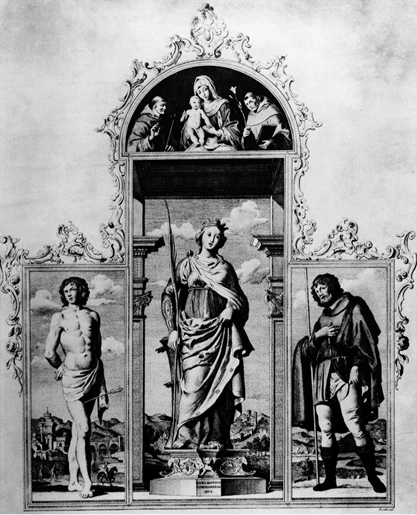
Engraving by A. Baratti reproducing the altarpiece of San Rocco by Cima da Conegliano in its original layout prior to the dispersion of the individual panels
In 1502 Giovanni Battista Cima da Conegliano painted an altarpiece for the church of San Rocco in Mestre, a polyptych on poplar wood panels, a work now dismembered which was composed of three panels and a lunette: Saint Catherine of Alexandria (152.2 x 77.8 cm) in the centre, Saint Sebastian on the left and Saint Roch on the right (each 114 x 46 cm), the Madonna and Child between Saints Francis of Assisi and Anthony of Padua (41 x 84.9 cm) above, the whole mounted on a wooden frame; The altarpiece was commissioned from the artist by the Scuola di San Rocco of Mestre (a confraternity founded on 1 April 1487) for the church of San Rocco, then entrusted to the Friars Minor Conventual, a church whose prior in 1502 was Germano da Casale, who later became prior of the church of Santa Maria dei Frari in Venice and also played an important role in the commissioning of the Assumption by Titian.
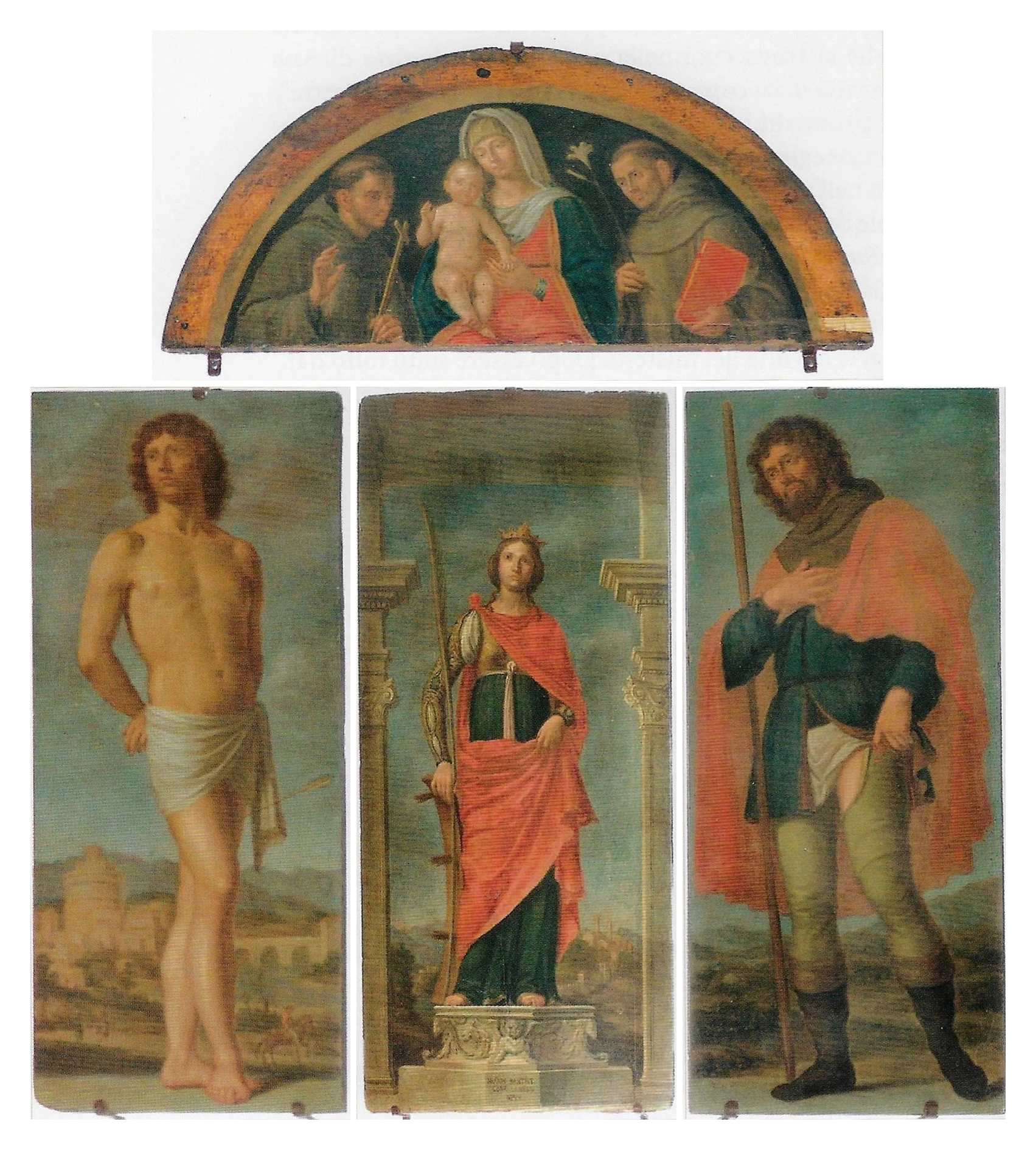
Copy of the altarpiece currently on display in the S. Lorenzo sacristy, restored by the Lions Club Mestre
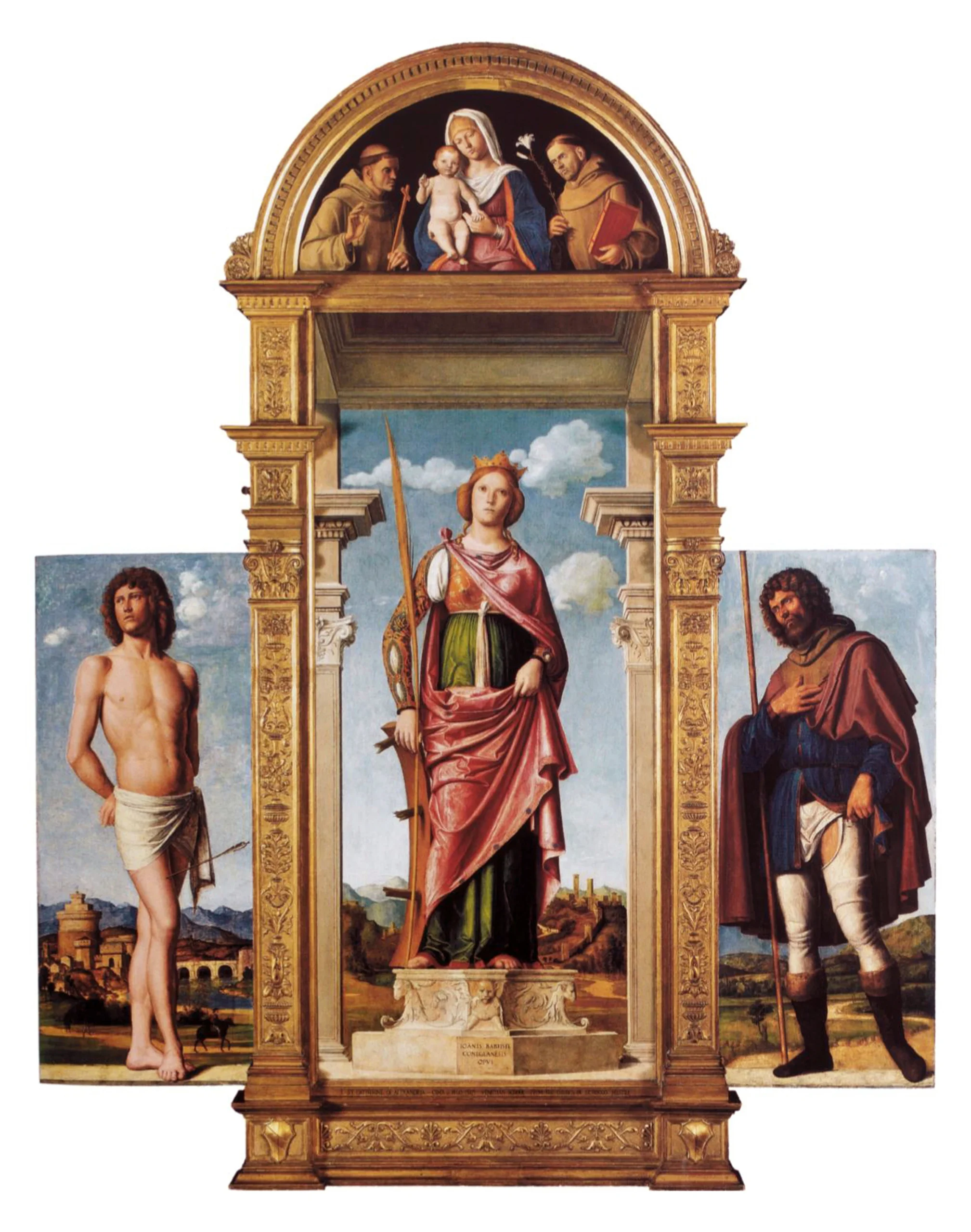
The altarpiece of St. Roch reconstructed in its original assemblage with the Virgin Mary with the infant Jesus and Saints Francis and Anthony of Padua in the lunette, Saint Catherine of Alexandria in the centre (The Wallace Collection, London), Saints Sebastian and Roch on the sides (both panels preserved in the Musée des Beaux-Arts, Strasbourg)
The altarpiece was removed from its original location in 1726 and replaced by a new stone altar. In 1769, the work was displayed on a side wall of the church in Mestre. In the same year, an oil copy was made on wood, a reproduction that is still preserved in the sacristy of the cathedral of San Lorenzo. Shortly afterwards, the original was purchased by the British resident (a sort of consul) John Strange, and was subsequently sold several times before finally being dismembered. The Saint Sebastian and Saint Roch are now in the Museum of Fine Arts in Strasbourg, while the panel with Saint Catherine and the lunette are on display at the Wallace Collection in London. In 1859, Richard Seymour Conway, 4th Marquess of Hertford, purchased the central panel for his own art collection in competition with the National Gallery in London, a testament to the artistic value attributed to the painting from Mestre. In 1933, what had become the Wallace Museum in 1897, following a donation to the State by Lady Amelie Julie Castelnau, Wallace's widow, purchased the lunette from a private collection with the aim of partially integrating the original layout of the polyptych, whose appearance is known thanks to an engraving by Baratti and the eighteenth-century copy in the cathedral of San Lorenzo. The central panel is signed Ioanis Babtiste Coneglanensis opus on the pedestal on which stands Saint Catherine, recognizable by the iconographic attributes of the broken wheel (the martyr's instrument of torture) and the crown (according to legend, Catherine, daughter of the King of Costa, refused to marry the emperor Maxentius, a pagan and persecutor of Christians); As for the lunette, it is likely the work of one of Cima's assistants, Andrea Busati, who collaborated with the master on the creation of the polyptych, a work which is also notable for the rarity of triptychs in the pictorial oeuvre of the artist from Conegliano.
The sale of the painting certainly represented a loss for Mestre's artistic heritage but also a significant chapter in the history of 19th-century art collecting.
Comparison between the reconstruction of the altarpiece in its original assembly and the engraving by A. Baratti
For comprehensive information on the history of the polyptych see pp. 258–263, The Wallace Collection, Catalogue of Pictures , London 1985, and pp. 58–69, Jill Dunkerton, The restoration of two panels by Cima da Conegliano from the Wallace Collection , in National Gallery Technical Bulletin, London 2000.