
Historical insights
The mayor - captain and the civic council
edited by: Sergio Barizza
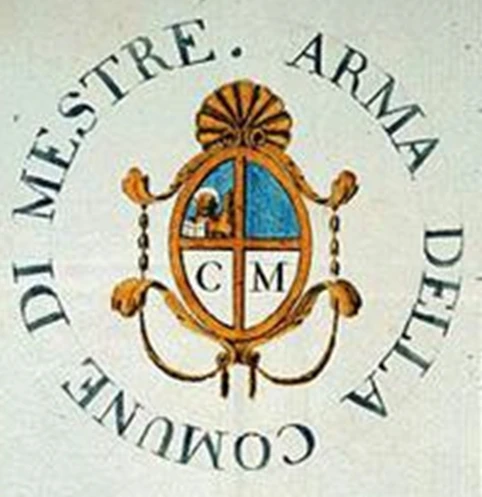
coat of arms of Mestre
In 1339, Doge Francesco Dandolo divided the Treviso territory into four podestàs, including that of Mestre. The ducal letter states that the podestà of Mestre included the following towns: Zelo, Zelarino, Trivignano, Terù, Assignano, Chirignago, Pirago, Parlano, Brusolo, Silvanerio, Spinea, Creda, Russignago, Orgnano, Campalto, Tombello, Tessera, Paliaga, Martellago, Pesegia, Cappella, Maerne, Favaro, Carpenedo, and Santa Maria di Dese. The community was headed by the Podestà, who was assisted by a magistrate with military functions called the Capitano del Borgo. During times of great political difficulty for the Republic, such as the war between Venice and Genoa, a Castellano was appointed for the castle of Mestre and the surrounding villages, as well as a Provvisore (administrator of the territory elected by the Senate).
With the end of the War of Chioggia in 1381, Mestre became the seat of the Podestà and Capitano, a Venetian nobleman elected by the Great Council of Venice, who held office for sixteen months. He was entrusted with institutional duties, primarily the administration of justice in the city and in the podestà's villas. He resided in the Palazzo Pretorio, located in the center of Mestre.
Two castellans, responsible for guarding the fortified sites along the lagoon edge—the Marghera Tower and the San Giuliano Tower—assisted him in carrying out his duties.
In 1452, a Civic Council was formed in Mestre, composed of representatives of the most important Mestre families. Its activity was aimed at resolving all matters relating to city life.
In 1457, the Council requested permission from the Podestà to build a new loggia for periodic meetings, replacing the old one, which was no longer usable.
It was built at the intersection of the road leading from the Porta di San Lorenzo and the Porta di Campocastello. This is the current Palazzo della Provvederia. Opposite, in 1459, the Palazzo del Comune was built, where the Civic Council meetings were held. Adjacent to the loggia, the Palazzo Podestarile was built, which housed the Podestà until the fall of the Republic. The Civic Council, under the presidency of the Podestà, appointed certain officials such as: "the estimators of the commun, the collector of public taxes, the mayors of the church of San Lorenzo, the physician of the Mestre district, and the advocate of the prisons."
Between 1508 and 1517, the war against the League of Cambrai was a tragic moment in the history of Mestre and the surrounding lands: in 1513, the city was besieged by Germans and Spanish troops, and the castle was sacked and burned.
At the end of the War of Cambrai, the Senate's concerns turned to the reconstruction of Mestre's walls, houses, and villages, and to resolving the hydrographic problems aimed at regulating and channeling the district's rivers, as the constant transport of debris posed a serious threat to the lagoon's silting.
From then on, the mainland remained untouched by warfare until the fall of the Republic, with its institutional structure unchanged.
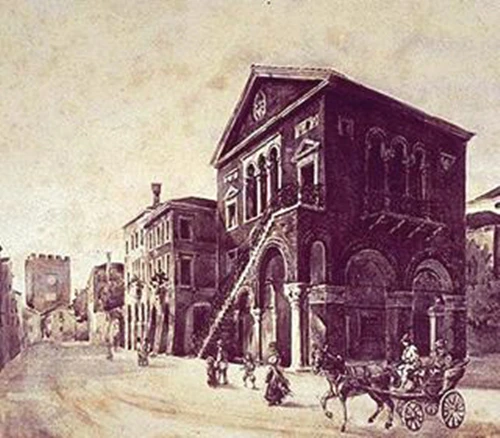
1909, the Palace of the Provvederia
Text by Sergio Barizza, from the CD-Rom "Mestre, History, Sources", edited by Sergio Barizza, Municipality of Venice - Municipal Historical Archives, 1988