
Historical insights
A column dedicated to articles published by leading historians in Mestre who collaborate with us.
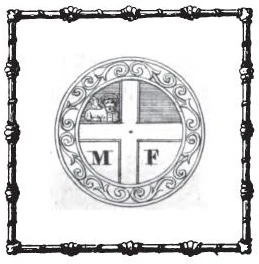
The podestà of Mestre from 1338 to 1797
edited by: Emiliano Balistreri
Mestre and its surrounding countryside came into Venetian hands in 1338 during the war against Mastino II della Scala, which began in 1336. The castle and village were then formally assigned to the Venetians during the reign of Francesco Dandolo by Emperor Louis IV the Bavarian. In fact, as early as 1336, the Venetians had sent an expeditionary force of around 500 men-at-arms to capture Mestre Castle, but were unsuccessful. They then attempted to gain possession of it through deception and treachery.
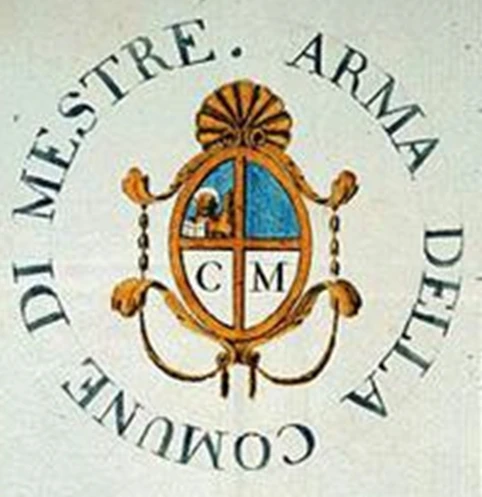
The mayor - captain and the civic council
edited by: Sergio Barizza
In 1339, Doge Francesco Dandolo divided the Treviso territory into four podestàs, including that of Mestre. The ducal letter states that the podestà of Mestre included the following towns: Zelo, Zelarino, Trivignano, Terù, Assignano, Chirignago, Pirago, Parlano, Brusolo, Silvanerio, Spinea, Creda, Russignago, Orgnano, Campalto, Tombello, Tessera, Paliaga, Martellago, Pesegia, Cappella, Maerne, Favaro, Carpenedo, and Santa Maria di Dese. The community was headed by a Podestà, who was supported by a magistrate with military functions.
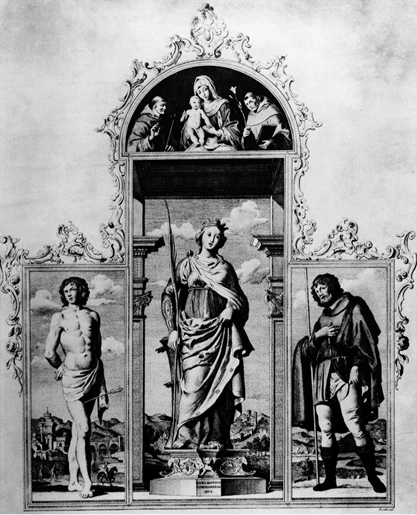
The altarpiece of Saint Roch by Cima da Conegliano
edited by: Emiliano Balistreri
In 1502, Giovanni Battista Cima da Conegliano painted an altarpiece for the church of San Rocco in Mestre, a triptych on poplar wood panels. This work, now dismembered, was composed of three panels and a lunette: Saint Catherine of Alexandria (152.2 x 77.8 cm) in the center, Saint Sebastian on the left and Saint Roch on the right (each 114 x 46 cm), the Madonna and Child with Saints Francis of Assisi and Anthony of Padua (41 x 84.9 cm) at the top, the whole mounted on a wooden frame. The triptych was commissioned from the artist by...
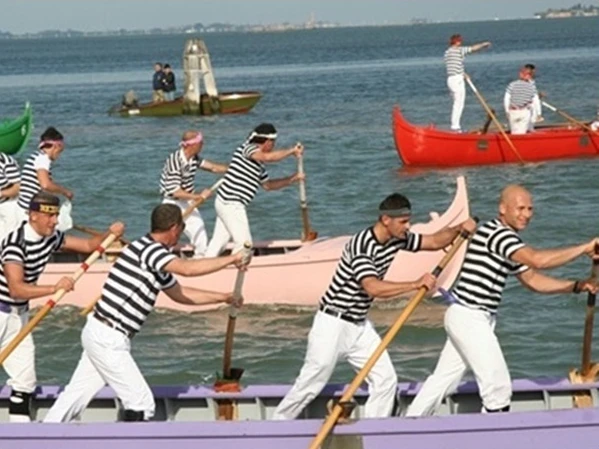
Regattas and Regatta Participants in Mestre
edited by: Giorgio & Maurizio Crovato
The Mestre Regatta is currently organized by the City of Venice, as part of the municipal regattas, in May, the first event in the lagoon rowing calendar. The current course begins in the Marani Canal (near the Murano Lighthouse), then passes the Nave Canal, the San Secondo Canal, the Paletto Pass, the Seno de la Sepa, and then returns to Punta San Giuliano to finish. The event features two races: the first, for women, in four-oared gondolas; the second, for men, in six-oared caorline boats. The Salso Canal, a true historic venue for the competition, is missing. We believe it is useful to retrace the history of the Mestre Regatta, from its origins to the 1920s and 1930s...
We're always available for clarification and to publish your historical articles.
You can contact us at prolocomestre@gmail.com or through the form on the contact page.